Maximize Your Sewer Line’s Lifespan
There is arguably no homeowner nightmare quite as visceral as a failing sewer line. It usually starts with subtle warning signs: a gurgling toilet, a shower drain that empties just a little too slowly, or a faint, unpleasant odor lingering in the basement. Then, one day, the system backs up entirely, sending raw sewage into your lowest floor drains.
Historically, clearing a stubborn, deep-seated blockage meant relying on highly corrosive chemical drain cleaners or mechanical snakes that offered only temporary relief. If the pipe was severely choked, fixing it meant hiring an excavator to tear a massive trench through your prized landscaping, ripping up your driveway, and leaving your property looking like a construction zone for weeks.
Fortunately, plumbing technology has evolved. Today, diagnosing, clearing, and even restoring sewer lines no longer requires destroying your yard. At the forefront of this plumbing revolution is hydro jetting—a highly advanced, incredibly powerful method of pipe maintenance.
If you are dealing with recurring clogs, slow drains, or want to proactively extend the life of your plumbing, this comprehensive guide will walk you through everything you need to know about maximizing your sewer line’s flow—from the raw power of hydro jetting to the minimally invasive magic of trenchless pipe restoration.

A sewer camera inspection reveals tree root intrusion.
The Crucial First Step: The Sewer Line Inspection
Before a single jet of water is fired into your plumbing, you need to know exactly what is happening underground. Plumbers used to have to guess the cause of a clog based on how the pipe behaved. Today, they rely on high-definition camera technology.
A professional sewer line inspection involves feeding a flexible, waterproof camera down your drain and into the main line. This transmits a live video feed to a monitor, allowing the technician to see the exact condition of your pipe’s interior.
Why is a sewer inspection so critical before hydro jetting? Because a professional must ensure your pipes are structurally sound enough to handle high-pressure water.
Common issues revealed during a camera inspection include:
- Tree Root Intrusion: Roots seek out moisture and nutrients, easily penetrating the joints of older clay or cast-iron pipes. Once inside, they grow rapidly, creating a massive, hair-like net that catches all solid waste.
- Grease and Scale Buildup: Years of pouring cooking oils down the kitchen sink, combined with the natural mineral scaling from hard water, can reduce a 4-inch pipe down to the diameter of a straw.
- Pipe Sagging (Bellies): If the ground shifts, a section of the pipe can sink, creating a “belly” where standing water and solid waste constantly pool and clog.
- Cracks and Collapses: Older pipes simply deteriorate over time. If the camera reveals a shattered pipe, cleaning it won’t fix the problem; the pipe must be repaired.
If the pipe is structurally intact but heavily blocked by roots, sludge, or scale, it is time for the ultimate pipe cleanse.
Hydro Jetting: The Ultimate Pipe Cleanse
When a standard plunger fails, most homeowners reach for a chemical drain cleaner or a rented mechanical snake. While snaking can punch a hole through a minor blockage, it is often a temporary band-aid. The snake’s metal coil simply pokes through the center of the clog, leaving thick layers of sticky grease and hardened mineral scale attached to the pipe walls. Within weeks or months, new debris catches on that remaining sludge, and the pipe backs up all over again.
Enter hydro jetting.
Also known as hydrojet plumbing, this technique uses a specialized, heavy-duty machine to blast highly pressurized water—often ranging from 3,000 to 4,000 PSI—through a flexible hose equipped with a specially engineered, multi-directional nozzle.
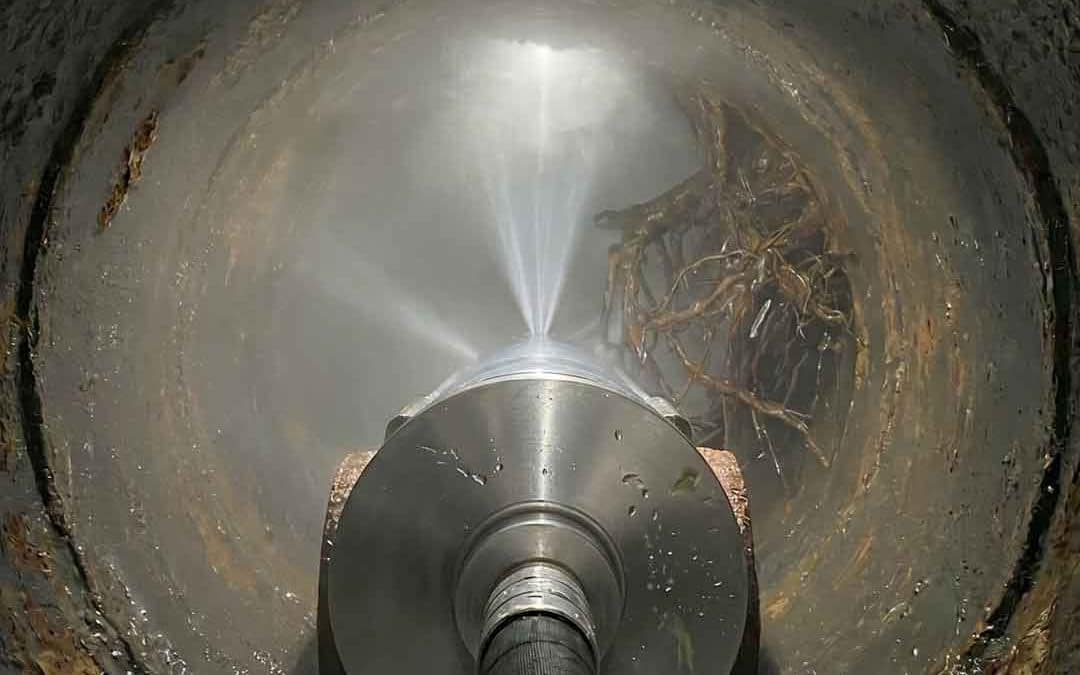
As the hose is fed down the sewer line, forward-facing jets break up the primary clog and slice through dense debris. Simultaneously, rear-facing jets scour the 360-degree interior walls of the pipe, flushing all the emulsified grease, pulverized roots, and mineral scale backward and safely out into the municipal sewer system.

The multi-directional jets of a hydro jet head.
Why Choose Hydro Jetting?
Opting for professional hydro jetting services offers several distinct advantages over traditional mechanical snaking:
- Complete Cleaning, Not Just Clearing: Hydro jetting doesn’t just punch a temporary hole; it strips the pipe walls completely bare, returning the interior to a “like-new” condition and maximizing the pipe’s flow capacity.
- Destroys Tree Roots: The high-pressure water acts like a liquid razor blade, cleanly slicing through dense tree root masses that would otherwise tangle, bend, or break a traditional snake cable.
- Safe and Eco-Friendly: Because it relies entirely on the kinetic force of plain water, hydro jetting eliminates the need to pour harsh, corrosive, and environmentally damaging chemicals into the water supply.
- Preventative Maintenance: Hydro jetting isn’t just for emergencies. Scheduling a hydro jetting service every 18 to 24 months is one of the best ways to maximize your sewer line’s lifespan, preventing the buildup of corrosive scale that causes pipes to prematurely age and crack.
Hydro Jetting vs. Snaking
To understand which service you need to maximize your plumbing’s lifespan, consider this quick comparison:
| Feature | Drain Snaking (Cable Auger) | Hydro Jetting |
| Best For | Minor, localized clogs (hair, paper, toys) | Severe blockages, roots, heavy grease, scale |
| Grease Removal | Ineffective (often just smears the grease) | Excellent (emulsifies and completely flushes grease) |
| Pipe Walls | Leaves sticky buildup on the pipe walls intact | Scours walls completely clean to their original diameter |
| Safety | Metal blades can scratch or scrape pipe interiors | Highly safe when pressure is calibrated by a professional |
Note: Hydro jetting is incredibly powerful. A trained professional must always perform a camera inspection first to ensure your pipes aren’t so old and brittle that the high-pressure water will damage them.
Beyond Cleaning: Trenchless Sewer Line Repair
Hydro jetting is a miracle worker for clogs, but what happens if your initial camera inspection reveals a pipe that is already cracked, badly corroded, or missing entire sections? Or, what if you want to permanently stop tree roots from ever returning?
You need a sewer line repair.
In the past, this meant renting an excavator and physically laying new pipe. Today, the industry standard has shifted to “trenchless” technology. Trenchless repair rehabilitates or replaces your underground pipes using only one or two small access pits, preserving your driveway, patios, and landscaping.
Interestingly, hydro jetting is the mandatory first step for trenchless repair. You cannot line a dirty pipe; the walls must be flawlessly clean for the new materials to bond.

Trenchless CIPP creates a new pipe inside the old one.
1. Sewer Lining Repair (Cured-In-Place Pipe – CIPP)
Sewer lining repair is the closest thing to magic in modern plumbing. Instead of removing the damaged pipe, plumbers create a brand-new pipe directly inside the old one.
Here is how the process works:
- Preparation: The existing pipe is thoroughly hydro jetted to remove all roots, scale, and debris, leaving a perfectly clean host pipe.
- Resin Saturation: A flexible, felt-like tube (the liner) is saturated with a specialized, two-part liquid epoxy resin.
- Insertion: The liner is inserted into the damaged pipe through a single access point, like a basement cleanout.
- Inflation and Curing: An internal bladder is inflated, pressing the resin-soaked liner tightly against the walls of the old, cracked pipe. Hot water, steam, or UV light is then used to cure the resin.
The Result: Once the bladder is removed, you are left with a seamless, joint-free, incredibly hard epoxy pipe inside the shell of the old pipe. Because it is seamless, a cured-in-place pipe is completely impervious to future tree root intrusion and boasts a lifespan of 50 to 100 years.
2. Pipe Bursting
If the old pipe is severely collapsed and cannot hold a liner, or if you need to upsize the pipe to handle more volume, pipe bursting is the alternative trenchless method.
This technique requires two small access pits. A heavy-duty steel cable is threaded through the old pipe. A cone-shaped bursting head is attached to the cable, followed immediately by a brand-new, flexible high-density polyethylene (HDPE) pipe. As powerful hydraulic machinery pulls the cable, the bursting head shatters the old pipe outward into the soil, simultaneously dragging the new pipe into place behind it.
Understanding the Costs in Canada
Whether you need a thorough hydro jetting cleanse to maximize flow or a complete structural fix, understanding the financial landscape is crucial. Costs vary based on your location, accessibility, and the severity of the issue, but here are typical averages for Canadian homeowners:
- Standard Snaking: $150 – $350. Good for minor, localized clogs near the fixture.
- Camera Inspection: $200 – $400. An essential diagnostic step that pays for itself by preventing misdiagnosis.
- Residential Hydro Jetting: $350 – $800. The ultimate preventative maintenance. Cost depends on the length of the line, the severity of root intrusion, and access point availability.
- Trenchless Sewer Lining (CIPP): $4,000 – $12,000+. While this sounds expensive, traditional open-trench excavation often costs just as much for the plumbing work alone, plus the massive secondary costs of repaving a driveway or hiring a landscaper to fix a destroyed yard.
Conclusion: Maximize Your System, Don’t Wait for a Disaster
Your sewer line is the unsung hero of your home’s infrastructure. Because it is buried underground, it is incredibly easy to ignore—right up until the moment it fails.
If you are experiencing frequent clogs, slow drains, or if you live in an older home with mature trees in the yard, do not wait for raw sewage to flood your basement. Proactive maintenance is vastly cheaper than emergency restoration.
Start with a professional sewer inspection to know exactly what you are dealing with. If your pipes are choked with grease, scale, and roots, a professional hydro jetting service will scour them clean and restore their maximum flow capacity. And if the pipe is failing structurally, hydro jetting paves the way for modern trenchless sewer line repair, saving your yard and your sanity. By utilizing these advanced technologies, you can maximize your plumbing’s lifespan and solve the messiest problems with minimal disruption to your home.